


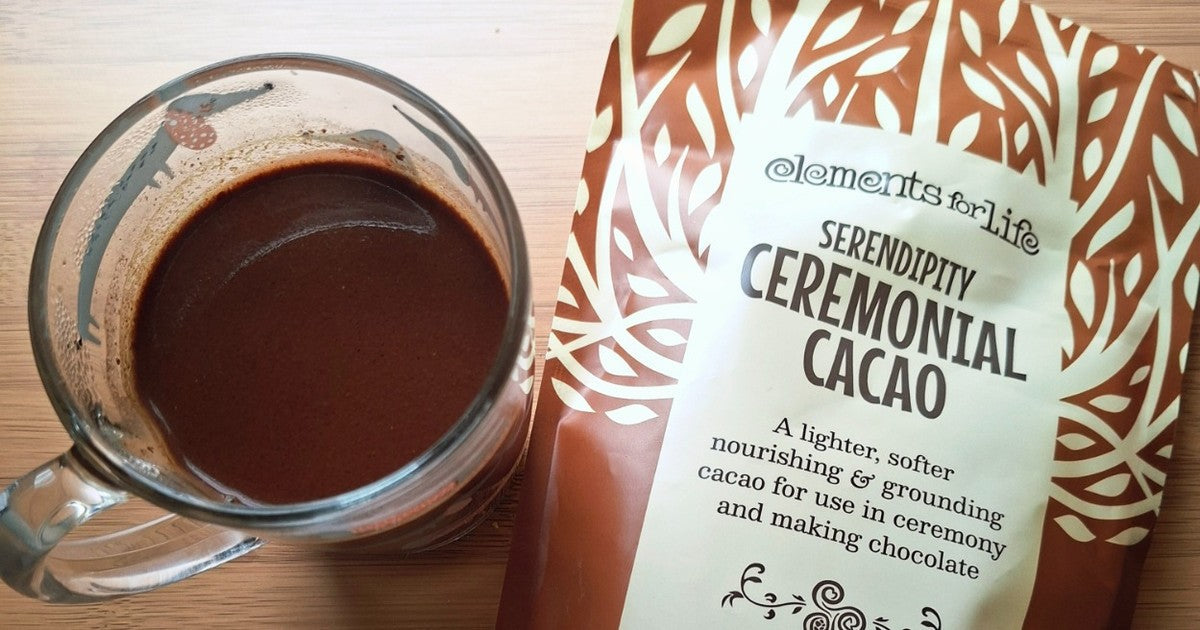

Why drink cacao, when a sachet of hot chocolate is sweeter and quicker?
Because of what's in the cup. The benefits of cacao come down to a handful of things, and a typical cup of pure cacao, 25 g whisked into about 200 ml of hot water with nothing added, has all of them. Around a fifth of a day's magnesium. Most of a day's copper. A couple of hundred milligrams of a natural stimulant that behaves quite differently from caffeine. And plant compounds called flavanols, which cacao has more of than almost any other food.
Below we take each in turn, looking at what it does in your body, how much a cup really gives you, and where the evidence runs out.
What's in a cup of cacao
Based on a typical cup of 25 g of pure cacao in about 200 ml of hot water.
| Per cup | Share of a day's reference amount1 | |
|---|---|---|
| Magnesium | about 80 mg | about a fifth (22%) |
| Copper | about 0.8 mg | most of a day (81%) |
| Manganese | about 1 mg | about half (52%) |
| Zinc | about 2.4 mg | about a quarter (24%) |
| Potassium | about 200 mg | about a tenth (10%) |
| Iron | up to about 4 mg | varies widely, see below |
| Fibre | about 4 g | |
| Cocoa flavanols | roughly 400 to 550 mg | twice the 200 mg linked to normal blood flow |
| Theobromine | about 200 to 300 mg | no reference amount |
| Caffeine | about 50 to 85 mg | a mug of filter coffee has 95 to 200 mg |
| Energy | about 160 kcal | mostly from the natural cacao butter |
These are typical values for pure, unsweetened cacao. Minerals, fibre and energy come from the USDA food database2, flavanols from published averages3, 4, and caffeine and theobromine are the typical values used in our Cacao vs Coffee article5.
They're always a guide. The amounts in any cacao shift with the variety, the farm and its soil, that year's weather and rainfall, and when in the season the beans were harvested.
Magnesium, copper and the other minerals
Magnesium is the one most people have heard of, and cacao is one of the richer food sources of it. A cup gives you around 80 mg.
Magnesium contributes to the reduction of tiredness and fatigue, to normal muscle function and to the normal functioning of the nervous system. That's the exact wording the UK and EU allow, because the evidence behind it has been checked6.
Copper gets far less attention, yet a cup carries most of a day's worth. Copper contributes to normal energy-yielding metabolism and to normal iron transport in the body6. There's also around half a day's manganese, a quarter of a day's zinc, and potassium in smaller amounts.
Iron is where the figures get wobbly. Published values for cacao vary a lot between analyses. The polyphenols in cacao also make it harder for your body to absorb the iron in plant foods eaten at the same time, and in one study a cocoa drink cut iron absorption from a bread meal by 71%7. So cacao isn't a reliable iron source. If you're watching your iron, have your cacao an hour or two away from iron-rich meals.

Theobromine: why cacao feels different from coffee
Theobromine (thee-oh-BRO-meen) is a natural stimulant, and cacao is the main place it turns up in our diet. The name comes from the cacao tree's Latin name, Theobroma cacao. It's a close chemical cousin of caffeine, which is why it gets called a gentler version.
A cup carries roughly 200 to 300 mg of theobromine. Three things make it behave differently from the caffeine in coffee.
- It's slower on. It builds over one to two hours, where caffeine arrives within 30 to 60 minutes.
- It's longer out. Your body takes 7 to 12 hours to clear half of it, against 3 to 5 hours for caffeine5.
- It doesn't push your blood pressure up. In a controlled trial, theobromine raised heart rate a little, more so at higher doses, but left blood pressure unchanged at every dose tested. Caffeine raised it8.
Many people describe cacao as a steadier, longer alertness than coffee, without the jolt and the dip, and those timings fit.
The evidence runs out on the feeling itself. In the best trials so far, theobromine on its own did little for mood or alertness at everyday doses8, 9, and at very high doses people felt worse, with headaches, nausea and anxiety. It's likely part of why bigger servings, around 40 g and up, can leave people feeling queasy. And because theobromine lingers, an afternoon cup can still be in your system at bedtime.
Cacao does contain some caffeine too, about 50 to 85 mg a cup, so the caffeine probably does more of the work than most cacao writing admits. Our Cacao vs Coffee article puts the two side by side in more detail.
Cocoa flavanols and blood flow
Flavanols are natural plant compounds also found in tea, apples, grapes and berries. Cacao beans are one of the richest sources known. Even cocoa powders that have been lightly or moderately processed still rank among the top tenth of foods the USDA has measured3.
Flavanols are the one part of cacao with their own authorised health claim. The approved wording in the UK and EU is: "Cocoa flavanols help maintain the elasticity of blood vessels, which contributes to normal blood flow." The effect comes from 200 mg of cocoa flavanols a day10.
On published averages, a cup of pure cacao clears that comfortably. In practice, flavanol levels vary from harvest to harvest and depend heavily on how the beans are fermented and handled, and nobody has published lab measurements for ceremonial cacao as a category. So it's likely, but not proven for any one bag.
Beyond blood flow, the picture is more modest than most cacao websites suggest. A Cochrane review of 35 trials found cocoa lowered blood pressure by about 2 mmHg on average, mainly in people whose blood pressure was already high, over a few weeks. Most of those trials had industry funding11.
COSMOS, the largest trial so far, gave 21,000 older adults cocoa flavanol capsules for 3.6 years. It didn't significantly reduce heart attacks, strokes and other cardiovascular events overall, which was its main question. You may see a 27% fall in heart-related deaths quoted from it. That was a secondary result, and it still needs confirming12.
A smaller story, then, but a real one. A daily food whose flavanols help keep blood flowing normally is worth having.
What about the "bliss molecule"?
You'll often read that cacao contains anandamide, the "bliss molecule", and phenylethylamine (PEA), the "love chemical", and that these lift your mood. The evidence doesn't back it.
The anandamide story traces back to a single 1996 letter in Nature. The amounts in cacao are tiny, and two years later other researchers showed that the main related compounds in chocolate don't act on the brain's cannabinoid receptors13. PEA is there, but only a few milligrams per kilo of chocolate, which makes it a tiny fraction of a milligram in a cup. Your body also has an enzyme whose main job is breaking PEA down14.
So why do so many people say cacao makes them feel good? Partly the gentle stimulant pairing above. One carefully designed trial found people taking a high dose of cocoa flavanols every day for a month felt calmer and more content, though a single dose did nothing15. And partly it's the drink itself. Something warm, made slowly, taken with a pause. No study has yet tested ceremonial cacao against a placebo ritual, so nobody can say how much of each is at work.
We're happy to keep researching that one ourselves, a cup at a time.
Why minimally processed matters
Everything above lives in the cacao bean, so the less that's done to it, the more of it reaches your cup.
Ceremonial cacao is the whole bean, shelled and ground into a paste, with its natural fat, cacao butter, still in it and nothing added. Cacao powder and cocoa are what's left once most of that butter has been pressed out. That's the real difference between ceremonial cacao and hot chocolate.
Most hot chocolate is made from cocoa powder, often treated with alkali to make it darker and milder. That treatment strips out flavanols, and heavily treated powders keep about a tenth of what natural powder has3. Then comes the refined sugar, and often milk powder.
Our vegan hot chocolate blends are made with untreated cacao powder instead, sweetened with coconut sugar, which has a lower glycaemic index than ordinary table sugar (54 against 65)16, 17. A cup of ceremonial cacao goes one step further, with nothing taken out and nothing added.
How much cacao a day, and who should be careful
There's no fixed amount. Around 25 g is a typical cup. If you're new to cacao, start with 10 to 20 g and see how it sits with you. Above about 40 g, plenty of people find it leaves them queasy or over-stimulated. Our post on the ceremonial dose goes into more detail.
Cacao suits most people, but not everyone in every situation. If you're pregnant or breastfeeding, or you take any medication, read Enjoying Cacao Safely first. And keep it well away from dogs, because theobromine is toxic to them18.
So, is cacao good for you?
Yes, in ways you can put numbers on. A cup of pure cacao gives you a fifth of a day's magnesium and most of a day's copper, a generous share of the flavanols linked to normal blood flow, and a slow, steady stimulant that doesn't spike your blood pressure the way coffee can. All with next to no sugar.
That's why people reach for cacao rather than a sugary hot chocolate. The science doesn't back every claim made for cacao, and it doesn't need to. What it does back is plenty to explain why a cup becomes a daily habit, and why people keep coming back to it.
References
Show all 18 references
- Regulation (EU) No 1169/2011, Annex XIII (retained in UK law): reference intakes for vitamins and minerals. https://www.legislation.gov.uk/eur/2011/1169/annex/XIII
- USDA FoodData Central. Baking chocolate, unsweetened, squares (FDC 167568). https://fdc.nal.usda.gov/
- Miller KB et al. (2008). Impact of alkalization on the antioxidant and flavanol content of commercial cocoa powders. J Agric Food Chem 56(18):8527-33. https://doi.org/10.1021/jf801670p
- Gu L et al. (2006). Procyanidin and catechin contents and antioxidant capacity of cocoa and chocolate products. J Agric Food Chem 54(11):4057-61. https://pubmed.ncbi.nlm.nih.gov/16719534/ ; USDA Database for the Flavonoid Content of Selected Foods, Release 3.3. https://www.ars.usda.gov/ARSUserFiles/80400535/Data/Flav/Flav3.3.pdf
- Elements for Life (2026). Cacao vs Coffee: What the science actually says. https://www.elementsforlife.co.uk/blogs/news/cacao-vs-coffee-what-the-science-actually-says
- Great Britain Nutrition and Health Claims (NHC) Register. https://www.gov.uk/government/publications/great-britain-nutrition-and-health-claims-nhc-register
- Hurrell RF, Reddy M, Cook JD (1999). Inhibition of non-haem iron absorption in man by polyphenolic-containing beverages. Br J Nutr 81(4):289-95. https://pubmed.ncbi.nlm.nih.gov/10999016/
- Baggott MJ et al. (2013). Psychopharmacology of theobromine in healthy volunteers. Psychopharmacology 228(1):109-18. https://pubmed.ncbi.nlm.nih.gov/23420115/
- Judelson DA et al. (2013). Effects of theobromine and caffeine on mood and vigilance. J Clin Psychopharmacol 33(4):499-506. https://pubmed.ncbi.nlm.nih.gov/23764688/
- EFSA NDA Panel (2012). Scientific Opinion on the substantiation of a health claim related to cocoa flavanols and maintenance of normal endothelium-dependent vasodilation. EFSA Journal 10(7):2809. https://www.efsa.europa.eu/en/efsajournal/pub/2809 ; authorised by Commission Regulation (EU) No 851/2013.
- Ried K, Fakler P, Stocks NP (2017). Effect of cocoa on blood pressure. Cochrane Database Syst Rev, CD008893. https://www.cochranelibrary.com/cdsr/doi/10.1002/14651858.CD008893.pub3/full
- Sesso HD et al. (2022). Effect of cocoa flavanol supplementation for the prevention of cardiovascular disease events: the COSMOS randomized clinical trial. Am J Clin Nutr 115(6):1490-1500. https://pmc.ncbi.nlm.nih.gov/articles/PMC9170467/
- di Tomaso E, Beltramo M, Piomelli D (1996). Brain cannabinoids in chocolate. Nature 382:677-678; Di Marzo V et al. (1998). Trick or treat from food endocannabinoids? Nature 396:636. https://www.nature.com/articles/25270
- Costa VM et al. (2022). Natural sympathomimetic drugs: from pharmacology to toxicology. Biomolecules 12(12):1793. https://europepmc.org/article/PMC/PMC9775352
- Pase MP et al. (2013). Cocoa polyphenols enhance positive mood states but not cognitive performance. J Psychopharmacol 27(5):451-8. https://pubmed.ncbi.nlm.nih.gov/23364814/
- University of Sydney Glycemic Index Research Service (2014). Coconut sugar tested at GI 54. https://glycemicindex.com/2014/05/qa-and-new-product-news-5/
- Atkinson FS, Foster-Powell K, Brand-Miller JC (2008). International tables of glycemic index and glycemic load values: 2008. Diabetes Care 31(12):2281-3 (sucrose GI 65). https://pmc.ncbi.nlm.nih.gov/articles/PMC2584181/
- Merck Veterinary Manual. Chocolate toxicosis in animals. https://www.merckvetmanual.com/toxicology/food-hazards/chocolate-toxicosis-in-animals


Leave a comment (all fields required)